
Text: Bibi van Haaren and Romée Pietersen
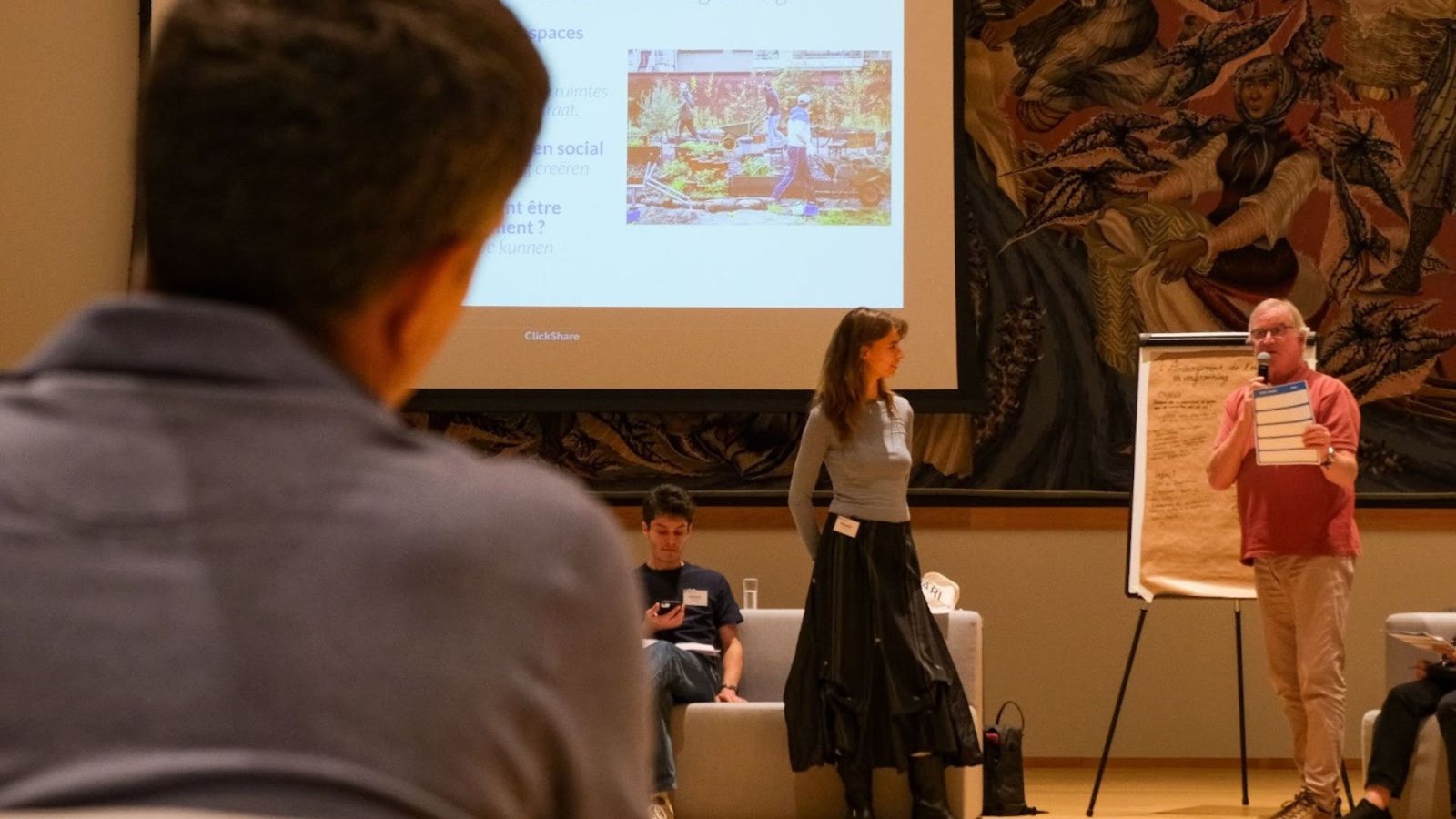
The town hall of Etterbeek is buzzing with excitement. Dozens of residents gather in the lobby, greeting each other as if they were old friends. They are the participants of the Climate Citizens’ Panel, a group of citizens who come together to think about the future of their municipality. A lot has happened since their last meeting in June, when the broad outlines of the climate plan were discussed.
Downstairs in the hall, people are laughing, shaking hands and catching up. Olivia, who chairs the panel on behalf of the municipality, welcomes everyone with a broad smile and leads the group to the meeting room on the first floor. The room fills with curious energy. After a short introduction, the second session can begin.
New Energy in the Room
Tonight, everything revolves around four themes from Etterbeek’s climate plan: more greenery in public spaces, less food waste, conscious consumption, and strengthening local resilience. The participants spread out across small tables, each with its own topic. Within minutes, ideas are flying across the table, from neighbourhood vegetable gardens to communal repair cafés.
The atmosphere is remarkably open and engaged, a far cry from the often sluggish tone of political debates. ‘At one point, I heard someone say, “Why should we actually vote? Can’t we just keep talking until we all agree?”’ says Maaike Berthoud of Dreamocracy, the organisation facilitating the process. ‘I thought that was so beautiful; it’s the exact opposite of how politics usually works.’
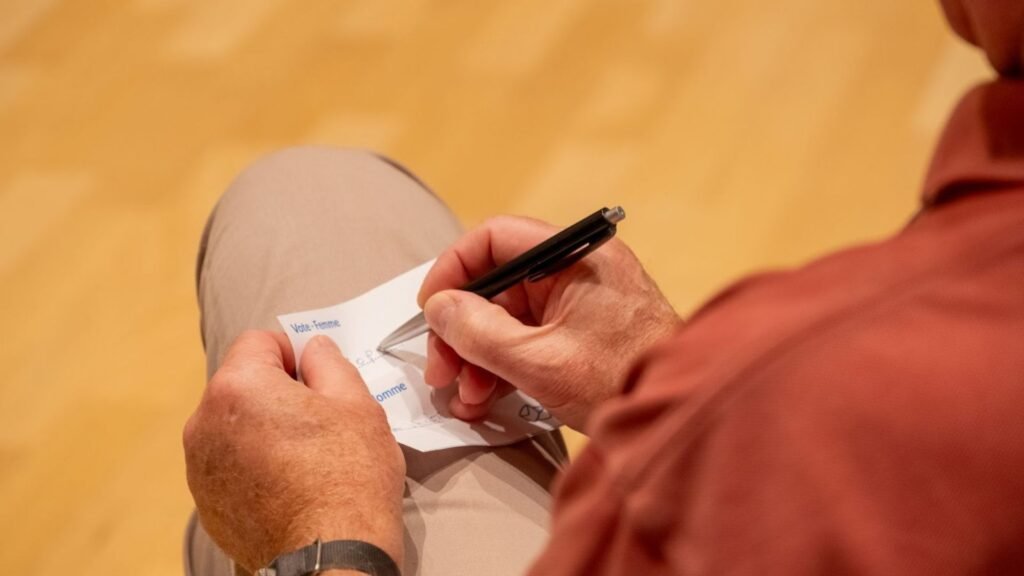
Etterbeek, 1 October 2025. Participants vote on the climate issue citizen panel. © Evi Schellens
Nevertheless, a choice must be made. Everyone gets three votes to distribute among the themes. In the end, “combating overconsumption” wins, narrowly ahead of “more greenery in public spaces”. Berthoud says with a smile: ‘People are so much better at contributing to policy than they often believe themselves. They just want to participate.’
The People Behind the Ideas
The citizens’ panel is a mixed group: young parents, pensioners, students, people who have lived here for decades and newcomers who are just getting to know Etterbeek.
Thomas, an engineer at Eurostar, sits at one of the tables littered with marker pens. ‘I want to show that we, the citizens, are involved in what happens in our city,’ he says. ‘Being a citizen is more than just voting; it’s about being part of the process.’ He believes in the power of local action: ‘If enough municipalities take action, it will have a real impact. Maybe not globally, but locally, and that’s what counts.’ He gets up from his table to write his group members’ ideas on the whiteboard at the head of the table.
A few chairs away sits grey-haired Ivan, wearing an old pink polo shirt. He has been a resident of Etterbeek since 1998 and is now retired. He has just come from babysitting his grandson, he says with a smile. ‘Since I retired, I have really experienced what it means to live in the city and do something for the community.’
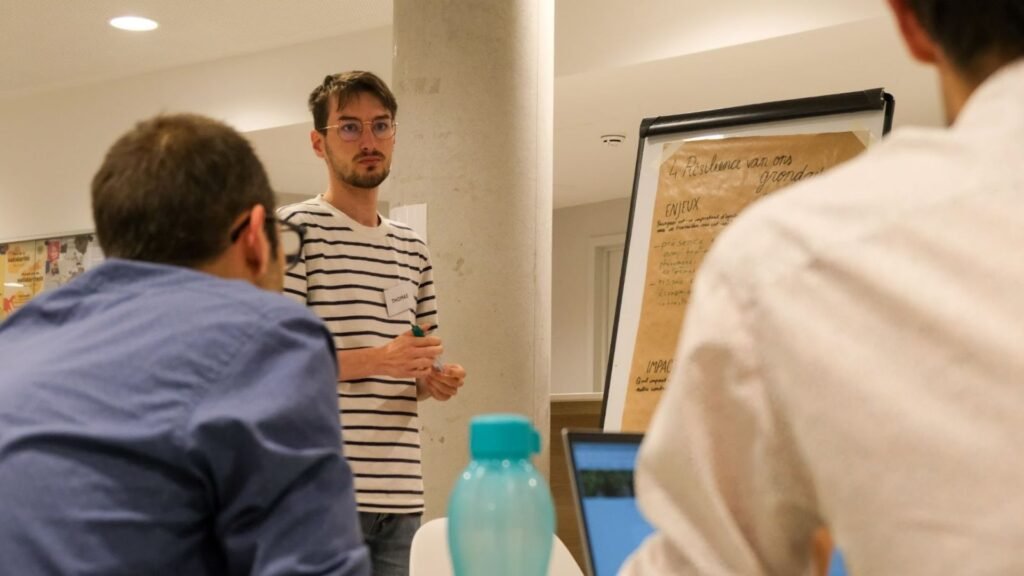
Etterbeek, 1 October 2025. Thomas, wearing a striped shirt, in discussion with his subgroup. © Evi Schellens
Small Voices, Big Meaning
Later that evening, there is another vote: the election of the co-chairs. As the mayor is absent, Olivia briefly explains what their task will be: to supervise and ensure that the results are recorded correctly. The vote is anonymous. Everyone chooses one man and one woman. Three candidates introduce themselves; one man hesitates, the two women say yes wholeheartedly and are elected. ‘Is that a problem?’ someone asks. ‘Not at all,’ smiles Berthoud from Dreamocracy. ‘On the contrary, it’s good that women are visible.’
At the end of the evening, Sophie, a freelance interpreter by profession, clutching on to a glass of apple juice, perfectly summed up the mood in the room: ‘I think these kinds of initiatives are great, moments when citizens really get a say in local policy. Even if it’s only advisory, I believe citizens can make a difference.’
Sophie worked in the group discussing food waste. ‘That topic is close to my heart, because I consciously try to cook and shop smart, less plastic, more bulk.’ Her proposal didn’t make it, but that doesn’t bother her: ‘Overconsumption is everywhere, on TV, on social media, on the street. It’s just too much’
Will the panel actually change anything? Sophie grins. ‘Come back in a year, and we’ll talk about it.’ That sentence sticks. Because what this evening made clear above all else is that democracy is alive and well, not as a cumbersome system of rules and votes, but as a lively conversation between neighbours who want to change something together.
